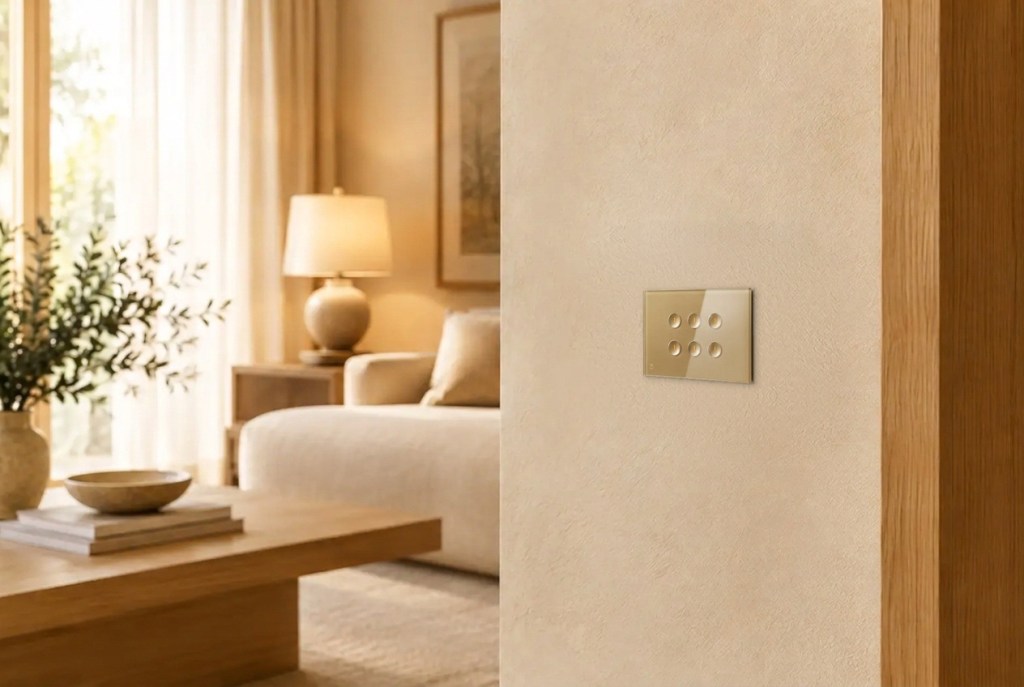
A wall switch is touched more often than almost any other detail in a home. It should not feel like an afterthought. Designer keypads make that everyday gesture quieter, clearer, and more personal, placing light, shades, and comfort controls behind a real-glass surface that belongs with the architecture.
For a penthouse, villa, boutique residence, or hospitality project, the question is rarely whether lighting should be controlled. It is how that control should feel at the wall. A keypad can either interrupt a carefully considered interior or become part of its visual language. The difference comes down to material, proportion, interface, and the intelligence behind each button.
Why designer keypads matter in refined interiors
The most successful interiors remove visual noise without removing choice. Residents still want to brighten a kitchen for preparation, soften a living room for guests, lower shades when afternoon sun reaches the floor, or adjust a bedroom’s temperature before sleep. They simply do not want separate switches, remotes, and thermostats competing for space on the wall.
A well-planned keypad brings those actions together. One tap can call up a lighting scene. Another can lower shutters or blinds. A dedicated climate control can keep a room comfortable without adding another plastic device to the room. The technology remains present when it is needed and quiet when it is not.
That restraint matters to designers as much as homeowners. A consistent keypad family can carry through entryways, kitchens, bedrooms, bathrooms, and corridors, even though each room has different needs. The wall feels intentional from one space to the next.
A glass surface with a point of view
Domex keypads are built around one real-glass faceplate family, available in three distinct styles: Core, Diviso, and Sculptured. This allows an interior designer to establish a single material language, then choose the expression that best suits the project. Core is clean and composed. Diviso introduces a more defined structure. Sculptured brings added dimension to the surface.
The choice does not stop at the profile. Black, White, Metallic Gray, and Metallic Gold finishes allow the keypad to complement dark stone, pale plaster, warm metals, timber, or a restrained monochrome palette. Gloss and matte options create another level of control. A glossy black plate can feel crisp beside reflective finishes; a matte white surface can recede gently into a softer wall treatment.
This is not decoration for its own sake. The keypad is an architectural touchpoint. It is seen at arrival, in the half-light of a hallway, and from across a room. A material that feels considered makes the home feel considered.
Backlighting that helps without taking over
Backlighting is often where a control interface either becomes useful or becomes distracting. Customized keypad backlighting can provide orientation after dark while preserving the intended mood of the room. In a bedroom, the glow should be calm. In a passageway, it should make the next action obvious without flooding the wall with light.
Personalized engraving adds another practical layer. Labels such as “Welcome,” “Dining,” “All Off,” or “Shades” replace guesswork with a direct cue. For a homeowner, that means immediate confidence. For guests, it means the house remains easy to use without a tutorial.
The best labels are brief and specific. They describe the experience, not the system behind it. “Evening” says more than a technical circuit name ever could.
One room, exactly right
Designer keypads earn their place when they respond to real routines. Consider the entry sequence. A resident arrives carrying bags, taps a scene, and the entry, kitchen, and living area settle into an inviting level. If the home includes motorized shades or shutters, they can be set for privacy at the same moment. One action replaces several small decisions.
In the living room, the needs change through the day. Bright light may support reading or conversation. Softer dimming can change the atmosphere for dinner. Shades can manage glare without closing the room off from its view. A keypad that combines these responses feels less like a collection of controls and more like a natural part of the room.
Bedrooms call for a different kind of intelligence. Here, control should be simple enough to use half awake. A bedside keypad can lower lights, close blinds, and call up a restful setting without reaching for a phone. Climate can be managed from an on-panel display with the appropriate controller, bringing temperature adjustment into the same composed glass language.
The keypad does not need to do everything in every room. A guest bathroom may only need lighting scenes. A principal suite may benefit from dimming, shades, and climate. Good planning gives each location the controls that make sense there, rather than filling every wall with functions no one will use.
Control that respects immediate choice
Automation is valuable when it reduces friction, not when it takes control away from the resident. Physical keypads remain important because they offer certainty. A familiar button is available the moment someone enters a room. There is no need to find a device, open an app, or remember a command.
At the same time, the Domex app extends control beyond the wall. Rooms, dimmers, scenes, and air conditioning can be organized in a clear interface, including a thermostat wheel for temperature adjustment. The keypad and app serve different moments: one provides immediate tactile control in the room; the other provides a broader view of the home.
The balance depends on the household. Some residents will use a few favorite scenes every day and rarely change them. Others will adjust lighting levels frequently as entertaining, work, and family routines change. A thoughtfully configured system accommodates both without making the interface feel complicated.
Designing for the systems behind the wall
A beautiful keypad is only as useful as the system it controls. Domex supports lighting, dimming, shutters and blinds, fans, boilers, and climate through purpose-built keypad options. A dimmer keypad can support up to six channels, while shutter and blind control can manage up to three channels. Climate control is available with an on-panel display for direct room adjustment.
The same glass design can connect through Domex Wireless mesh, Cresnet, or Modbus. That flexibility matters in projects where the control architecture has already been defined. Domex also integrates with KNX through a two-way IP gateway, allowing Domex keypads to control KNX lighting, dimmers, shutters, and shades, while KNX keypads can control Domex switches.
For Crestron projects, Domex Works With Crestron Home OS through the DX-ElectB-CRSNT Cresnet keypad. It is available with one to nine button options, in horizontal or vertical orientation, with multiple design combinations. The result is a keypad choice that can remain consistent with the interior while fitting the wider control plan.
These details should guide specification early, not be treated as an installation-day decision. The number of circuits, shade groups, desired scenes, climate zones, and wall locations all shape the final experience. Early coordination with an architect, interior designer, electrical team, and certified dealer prevents a beautiful wall plate from being asked to solve an unclear control plan.
Personalization without visual clutter
The temptation in a smart home is to create a button for every possible action. That usually produces the opposite of luxury: too many choices, too much text, and uncertainty at the moment of use.
A stronger approach begins with moments. What should happen when someone wakes up, returns home, starts cooking, welcomes guests, watches the evening settle in, or prepares the house for sleep? Those moments become scenes. The most useful functions remain visible. Less frequent settings can live in the app or be assigned to a more considered control page.
Button quantity is therefore not a measure of capability. A compact keypad can be exactly right in a secondary bedroom. A larger arrangement may be appropriate near a main living area or entrance. Horizontal and vertical orientations should follow wall proportions, furniture placement, and the way a hand naturally approaches the control.
The value of expert configuration
A home control system should feel finished when the resident moves in, not like a set of features waiting to be figured out. Each Domex system is designed, configured in PCC, installed, and tuned by a certified dealer. That process turns product capability into a home that responds in a way that feels personal.
The tuning phase is where details become meaningful. A scene may need warmer light, a lower dimming level, a different shade position, or a clearer engraved label. These are small adjustments, but they determine whether the system becomes part of daily life or remains something admired only at handover.
The right keypad does more than replace switches. It gives the resident a calm, immediate relationship with the home. Choose the glass, finish, labels, and functions with the same care given to lighting fixtures and hardware, and every touch on the wall can feel exactly right.